Published on 12 Jan 2026 by admin website
Artificial intelligence (AI) continues to evolve with improved diagnostic abilities, individualized patient treatments, and enhanced surgical accuracy. Some key developments include the analysis of retinal scans that provide earlier disease detection and the ability to spot tumors on slit-lamp photographs. Another advance is more individualized cataract surgery thus enhancing precision and visual outcomes.
AI currently is at the forefront of ophthalmologists’ minds. When asked about technologic advances in 2025, a recent survey found that ophthalmologists identified AI as by far the “most transformative trend in ophthalmology.”1
The survey found AI to be the clear frontrunner among available technologies, cited by 78% of respondents. The next cited trend, at a distance 11%, was age-related macular degeneration/geographic atrophy treatments in the pipeline.
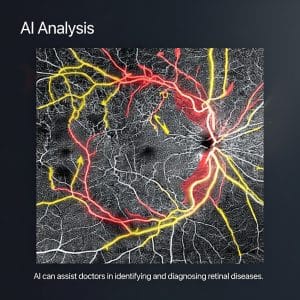
A press release from the American Academy of Ophthalmology5 highlighted a population-based cohort study conducted by researchers at the University College London Institute of Ophthalmology and Moorfields Eye Hospital, London, that compared the ability of an AI algorithm with a human grader to ferret out cases of glaucoma among 6,304 fundus images.
The investigators reported that patients with glaucoma were correctly identified by the algorithm in 88% to 90% of cases in contrast to the 79% to 81% by human graders.
Precise analyses of ocular scans give ophthalmologists the freedom to adjust follow-up visits and chose the most appropriate treatments.2
AI algorithms can markedly impact clinical trials by identifying eligible patients rapidly and accelerating the recruiting of those patients. AI also can streamline the trials by decreasing the numbers of patients needed and the timelines involved.
“Clinical trial recruitment is a crucial step in medical research that often faces significant obstacles. Statistics reveal that around 80% of clinical trials fail to enroll participants on time, leading to delays that can extend the timelines by several months or even years. This is particularly concerning in disease areas needing urgent solutions, such as cancer or Alzheimer’s, where time is of the essence. The average time for recruitment is approximately 20% of the total trial duration, highlighting the inefficiency in current practices,”23 according to a report from Scientific Research in Hospital Solutions.
AI can identify suitable candidates more quickly, which reduces recruitment timelines and improves quality of trial participation, thus enhancing efficiency as well as paving the way for more effective treatment discoveries.23