Published on 29 Sep 2025 by rovertech
Short-sightedness, or myopia in technical terms, is becoming increasingly common in our modern world. Myopia is characterized by difficulty seeing distant things. As a consequence, short-sighted people perceive objects at a distance indistinctly or blurred. Conversely, they can clearly see closer objects.

Light enters the eye, passing through the cornea, pupil, lens, and aqueous humour. The lens focusses the light and projects an image onto the retina. This is where the photoreceptors are located. These photoreceptors transmit the information to the brain via the optic nerve, enabling us to see the image.

This form of myopia occurs when the eyeball is too long. The focal point is located in front of the retina. This causes an unclear image on the surface of the retina, which is then also perceived as blurry by the brain.

This form of myopia occurs when the refractive power of the lens and cornea is too high. The focal point is located in front of the retina. This causes an unclear image on the surface of the retina, which is then also perceived as blurry by the brain.
When it comes to the spread of myopia some studies already speak of an epidemic. The well-known Brien Holden Vision Institute has forecast that by the year 2050 one out of two individuals could be affected by myopia. That is alarming, and it makes it more than clear that early detection and management of myopia are becoming more and more important. For there is no other way to effectively reduce the risks of myopia in children and adolescents.
A comparison illustrates the rapidity of this development: In the year 2000 22.9% of the global population were affected by myopia and 2.7% had high myopia beyond -5 diopters. According to Brien Holden’s forecast, by 2050, 50% of the world’s population could be myopic and at least 10% could be suffering from high myopia. The development is also dramatic within Europe. According to data recently presented by the European Eye Epidemiology Consortium, more than 47% Europeans between 25 and 29 years of age are myopic
Those affected also have a greater risk of developing severe eye disease such as cataract or retinal detachment and eventual blindness. In general it can be said, that the earlier the myopia onset, the higher will be the myopia in the adulthood and the higher will be the risk for severe eye disease.

Why is short-sightedness becoming increasingly common among children? The trend in recent years is alarming. Every second child under the age of 10 is or will become short-sighted. In 2000, 22.9% of the world’s population was affected by myopia. According to the Brien Holden Vision Institute, 50% of the world’s population could suffer from myopia by 2050. The trend in Europe is also alarming. Currently, a good 47% of 25 to 29-year-olds are short-sighted.
Tablets, smartphones, and laptops have a massive influence on media consumption today. At the same time, they are also a new source of strain on the eyes. People often check their e-mails or read the news on their smartphones first thing in the morning. Then, they usually spend hours working at a computer. Constant close-range vision like this significantly increases myopia. At the same time, it is not just a matter of screen time but also the intensive use of digital devices in general. This is becoming increasingly prevalent, particularly among children. Interestingly, there are clear international differences.
People in Asia spend an average of 14 hours a day on the Internet compared to 6 hours in the USA. In addition, people in these countries also neglect outdoor activities in natural and bright light. Australia is a different story: Here, only 30% of 17-year-olds are short-sighted. At the same time, Australians have more than three hours of activity per day. This is well above the average for Americans, Asians, and Europeans, with a maximum of between one and two hours a day. This is a major disadvantage for the eyes.
Those affected can still see perfectly at close range. This is why they can usually read or work using a screen without any problems.
Myopia becomes noticeable when recognising distant objects.
The image becomes blurred, as described above.
The following symptoms may be signs of myopia:
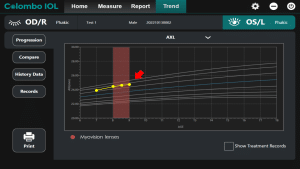
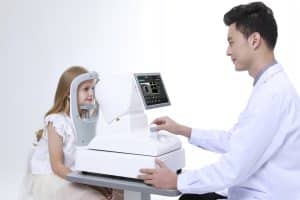
Regular eye growth checks are an essential aspect of successful myopia management. The Motim®Colombo AXL Wave show eye growth in detail and visualize the success of your treatment. The annual growth in eye length is calculated and documented. The software visualizes the success of the treatment measures, such as Ortho-K lenses or special myopia spectacle lenses. If the treatment does not have the desired effect, you can use the information to optimize your treatment. The documentation supports your communication with your customer.
In addition, you can also precisely predict how the myopia will develop in the future. Using the guided myopia software gives you greater security and creates a more convincing experience for the customer. Simply structured, intuitive to use, and incomparably precise. Your perfect start to treating an increasingly important issue! This simple and professional myopia management concept enables you to achieve satisfied customers in 5 simple steps: