Published on 25 Jun 2026 by admin website
Comparison: Why Device Technology and Wavelength Matter in Challenging Media
When imaging patients with significant media opacities(such as dense Cataracts or pupillary miosis)
the choice of our diagnostic equipment directly impacts our clinical confidence.
Here is a compelling sidebyside comparison of the exact same eye (Right Eye, nondilated, Diabetic (63-year-old male) captured on the same day using two different SS-OCT platforms
Topcon (left) vs. TowardPi (right).
Case Analysis & Visual Comparison
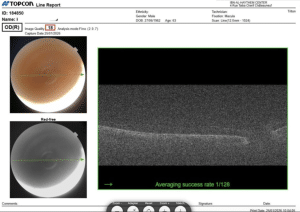
Left Image (Topcon Line Report):
Signal Quality: 18 (low signal profile due to media limits).
Averaging: Success rate of 1/128.
B-scan Visibility: The retinal profile is heavily attenuated, and the choroidal boundary is nearly undetectable. The dense opacity and small pupil size significantly degraded the light backscatter.
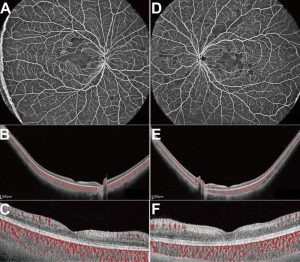
Right Image (TowardPi 3D Retina Report):
B-scan & Tomogram Visibility: Clear visualization of the vitreo-retinal interface, retinal layers, and deep choroidal structures despite the absence of mydriasis.
Topography & Thickness Maps: Full, actionable macular thickness map and ETDRS grid sectoring obtained successfully.
💡 Why the Significant Difference? Scientific Explanations
While both devices utilize Swept-Source OCT (SS-OCT) technology—which inherently outperforms traditional SD-OCT in tissue penetration—several distinct technical parameters explain this variance in performance:
Wavelength & Laser Source Power: Longer wavelengths (typically around 1050 nm to 1060 nm for premium SS-OCT) experience significantly less scattering through opaque media like dense nuclear cataracts compared to shorter wavelengths. Subtle differences in the light source sweep rate and peak power output can drastically alter the signal-to-noise ratio (SNR) in undilated eyes.
Tracking & Averaging Algorithms: The ability to register and average scans in real-time under low-light or small-pupil conditions relies heavily on hardware-based eye-tracking and advanced software reconstruction. TowardPi’s processing algorithms appear to effectively reconstruct structural details even when the raw photon return is severely limited.
Optical Path Design and Aperture Optimization: Some newer SS-OCT systems feature optical designs specifically optimized to capture peripheral or low-intensity backscattered light entering through small pupil diameters (miosis), maximizing the data collected per scan lines.
👁️ Clinical Takeaway
Technology matters. In a high-volume surgical center, relying on an OCT platform that can bypass media opacities and miosis without mandatory dilation saves crucial clinical time and ensures we never miss underlying macular pathology prior to cataract surgery.