Published on 29 Jun 2026 by admin website
A cataract is a clouding of the lens of the eye, which is typically clear. For people who have cataracts, seeing through cloudy lenses is often like looking through a frosty or fogged-up window. Clouded vision caused by cataracts can make it hard to read, drive a car at night or see the expression on a friend’s face.
Most cataracts develop slowly and don’t disturb eyesight early on. But with time, cataracts will eventually affect vision.
At first, stronger lighting and eyeglasses can help deal with cataracts. But if impaired vision affects usual activities, cataract surgery might be needed. Cataract surgery is generally a safe, effective procedure.

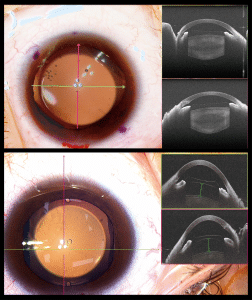
A cataract occurs when the lens of your eye becomes cloudy. Eventually, a cataract can become like the one shown in this person’s right eye.

Clear vision, like on the left, becomes blurred as a cataract forms, like on the right.
Symptoms of cataracts include:
Clouded, blurred or dim vision.
Need for brighter light for reading and other activities.
Trouble seeing in sunlight or bright lights.
Trouble seeing at night.
Halos or starbursts around lights at night.
Frequent changes in eyeglass or contact lens prescription.
Fading or yellowing of colors.
Double vision in one eye.
At first, the cloudiness in vision caused by a cataract may affect only a small part of the eye’s lens. Vision loss may be slight at first. As the cataract progresses, it clouds more of the lens. More clouding changes the light passing through the lens. This may lead to symptoms being more noticeable and symptoms that affect everyday activities.
Make an appointment for an eye exam if you notice any changes in your vision. If you develop sudden vision changes, such as double vision or flashes of light, sudden eye pain, or a sudden headache, see a member of your healthcare team right away.
MIDAS -— Anytime, Anywhere
Powered by cutting-edge AI, the MIDAS Cataract Analyzer makes cataract assessment fast and accessible to everyone — no ophthalmology expertise required.
Using just a smartphone, MIDAS delivers instant analysis and provides the world’s first and only quantitative Cataract Index based on big data.
From today, nurses, general practitioners, optometrists, and even caregivers in nursing homes can simply connect the MIDAS device to a smartphone, record a short corneal video, and upload it to the AI platform. In just 30 seconds, you’ll receive a precise report detailing the cataract grade and whether surgical intervention is recommended.
For more details, please contact us.